
Amplified Landline Phone for Seniors
3.9Editor score
100dB ringer volume
Photo speed dial buttons
Hearing aid compatible
This guide compares the top captioned telephones for hearing impaired users, evaluating features like real-time captions, amplification, and usability for
Captioned telephones provide a vital lifeline for individuals with hearing loss, allowing them to read real-time text while listening to conversations. These devices combine audio amplification with visual text displays to ensure no word is missed during critical calls. Choosing the right model depends on specific hearing needs, internet connectivity, and desired features like screen size or button layout.
Our team evaluated the leading captioned and amplified phones available in the market to identify the most reliable options for seniors and hard-of-hearing users. We considered factors such as caption accuracy, sound clarity, ease of use, and compatibility with hearing aids. This list covers a range of devices from budget-friendly corded phones to advanced touchscreen models with internet-based captioning services.
Each pick in this guide highlights key strengths and potential trade-offs to help you find the perfect device for your home or care facility. Please note that product availability and specific features may change over time, so always check the latest details before purchasing. We aim to provide honest insights based on official specifications and user feedback to support your decision-making process.
3.9Editor score

4.3Editor score

The following table provides a side-by-side comparison of all ten products reviewed in this guide. Each entry highlights essential specifications and features to help you quickly identify which device best matches your specific communication needs and home setup requirements.




The Hamilton CapTel 2400iSPNBT stands out as a top choice for those needing reliable captioned telephone service. With a rating of 4.3 stars, users appreciate its ability to turn everyday calls into clear conversations by displaying real-time text on a large touchscreen. This device bridges the gap between listening and reading, ensuring no important words are missed during critical communications with family or medical providers.
We may earn a commission when you buy through this link, at no additional cost to you.
Its standout feature is the dual captioning mode, allowing users to choose between fully automated captions or assisted captions with live operator support. The built-in answering machine also displays voicemail captions directly on the screen, which is a significant benefit for reviewing messages at a convenient time. The hearing aid compatible design and up to 40dB amplified gain make it suitable for various levels of hearing loss without requiring additional accessories.
While the device offers extensive features, it does require a high-speed internet connection and is only available for US residents who register for the service. This limitation might be a hurdle for some users depending on their location or internet reliability. However, the 24/7 nationwide captioning service provided at no cost offsets these requirements for many who prioritize clarity and confidence in their phone interactions.
Anyone seeking a premium captioned telephone solution with robust support features should consider this model. It is particularly well-suited for seniors or individuals with moderate hearing loss who want the security of reading what they hear. The combination of visual and auditory feedback provides a comprehensive communication experience that many find essential for staying connected.
The large touchscreen displays captions in real time, allowing users to read and listen simultaneously for better comprehension.
Users can switch between auto captions and assisted captions with live operator support depending on the call situation.
We may earn a commission when you buy through this link, at no additional cost to you.
The Geemarc Ampli550 is designed specifically to help hard-of-hearing individuals make and hear phone calls with greater ease. It combines a loud ringer with an extra bright flashing strobe to ensure incoming calls are never missed. The device offers up to 55dB of clear sound and is compatible with various hearing aid accessories, making it a versatile choice for seniors and those with significant hearing loss.
We may earn a commission when you buy through this link, at no additional cost to you.
Key features include a large backlit LCD display and an extra-large keypad that makes dialing simple even for users with vision difficulties. The talking caller ID and talking keys provide audio feedback when buttons are pressed, reducing the need to squint at small numbers. Additionally, the phone includes nine one-touch memory dial buttons and three emergency keys for quick access to important contacts during critical moments.
Some users may find the price higher compared to standard amplified phones, and the device requires a standard electrical power source to function fully. The flashing strobe and high volume settings are beneficial but can be overwhelming if not adjusted properly. However, for those who have struggled to hear standard ringers or keypad tones, these features provide the necessary accessibility to stay connected safely.
This phone is an excellent choice for individuals who need extra volume and visual alerts to manage calls effectively. It serves well as a gift for loved ones with hearing impairments due to its thoughtful design and ease of use. The award-winning brand reputation ensures reliability and support for users seeking long-term communication solutions at home.
The 95dB ringer combined with a flashing strobe ensures users are alerted even in noisy environments.
Talking keys and caller ID read out numbers and names aloud to assist users with low vision.
We may earn a commission when you buy through this link, at no additional cost to you.
The Captel MDL 200 is a straightforward corded phone designed specifically for the hearing impaired. While detailed specifications are not provided in the available data, the device focuses on delivering reliable telephone functions without unnecessary complexity. Its simplicity makes it an attractive option for users who prefer traditional phone usage over smart or digital systems.
We may earn a commission when you buy through this link, at no additional cost to you.
This model likely offers basic amplification or comfort features suitable for individuals who do not require advanced digital capabilities. The corded nature ensures a stable connection, which can be crucial in areas where wireless signals might be inconsistent. It represents a minimalistic approach to accessibility, prioritizing function over form to meet essential communication needs.
The lack of detailed product information makes it challenging to assess specific features like volume levels or compatibility. Users seeking advanced options such as caller ID or answering machines might find this model too basic. However, for those looking for a dependable phone that just works without the need for internet or complex programming, it serves its purpose well.
This phone is best suited for users who value simplicity and reliability above all else. It may be ideal for caregivers looking for a secondary phone or for those in low-tech environments. As with any device for the hearing impaired, verifying specific amplification features before purchase is recommended to ensure it meets individual needs.
The corded design ensures a stable connection without relying on wireless networks or power-dependent features.
We may earn a commission when you buy through this link, at no additional cost to you.
The Clarity AltoPlus is a premium amplified phone certified for mild, moderate, and severe hearing loss with up to 53dB of amplification. It offers a unique Outgoing Speech Amplification feature that makes your own voice louder for the other caller, ensuring two-way clarity during conversations. The device is ergonomically designed with tone and volume controls that are accessible even for those with arthritis.
We may earn a commission when you buy through this link, at no additional cost to you.
Its 100dB ringer with visual indicator ensures that incoming calls are never missed, while the backlit screen with large font aids visibility. The talking keypad system, known as Clarity Voice Assist, provides auditory feedback to assist users who may struggle with small buttons. Additionally, the phone supports various accessories like headsets and neckloops through dedicated jacks for enhanced audio delivery.
While the AltoPlus offers advanced features, it does not include batteries for backup power, which might be a consideration for those prone to outages. The higher price point reflects its specialized capabilities but may be a barrier for some budgets. However, the professional-grade amplification and accessibility features make it a strong contender for serious hearing loss users.
This phone is ideal for individuals who need professional-grade amplification and want to be heard clearly by others. It is particularly beneficial for those who have difficulty projecting their voice as well as hearing incoming calls. The ergonomic design and comprehensive connectivity options make it a versatile choice for various home environments.
Outgoing Speech Amplification boosts your voice volume so others can hear you clearly without straining.
Ergonomic controls and talking keypad help users with arthritis or vision issues navigate the phone easily.
We may earn a commission when you buy through this link, at no additional cost to you.
The Serene Innovations SI-CL-65 is a cordless phone featuring HD sound and a talking caller ID system. This design allows users to move freely around the home while maintaining access to their phone line. The high-definition audio quality helps ensure that voices are clear and distinct, which is a significant advantage for those with mild hearing difficulties.
We may earn a commission when you buy through this link, at no additional cost to you.
The talking caller ID feature announces the name or number of incoming calls, aiding users with visual impairments or low vision. As a cordless model, it offers the convenience of answering calls from different rooms without being tethered to a base station. It integrates with standard landline services, making it easy to install in existing home setups.
Specific amplification levels are not detailed in the available data, which may be a consideration for users with severe hearing loss. The cordless design requires regular charging to ensure the handset is always ready for use. Despite these minor inconveniences, the combination of HD sound and mobility makes it a practical choice for daily communication needs.
This phone suits users who need the flexibility of cordless calling with some audio clarity features. It is well-suited for those who value mobility but still prefer traditional landline reliability. The brand focuses on notification needs, suggesting a focus on ensuring users never miss important calls regardless of location in the home.
The cordless design allows users to answer calls from anywhere within the home without being near a fixed base.
We may earn a commission when you buy through this link, at no additional cost to you.
The VTech SN5147 is a hybrid system designed specifically for seniors that includes both a corded base and a cordless handset. This combination ensures reliability during power outages while offering mobility through the wireless handset. It features an extra-loud 90dB ringer with a flashing visual indicator to help users notice calls even in noisy environments.
We may earn a commission when you buy through this link, at no additional cost to you.
One of its standout features is the photo dial capability, which includes slots to store pictures of family members for one-touch calling. This visual aid is particularly helpful for users with memory issues or those who struggle to remember phone numbers. The phone also includes a smart call blocker to prevent up to 1,000 robocalls, adding a layer of security to daily communication.
While the system can be expanded with additional handsets, the base model comes with one handset which might be limiting for large homes. The digital answering machine allows for remote access and slow playback, which helps in reviewing messages carefully. However, users may need to invest extra time to set up the photo slots effectively.
This phone is highly recommended for seniors who need a mix of reliability and ease of use. The visual dialing and call blocking features address common pain points for older adults seeking to stay connected without confusion. It serves as a comprehensive solution for both outgoing and incoming communication management at home.
Photo slots allow users to call loved ones by pressing an image rather than remembering a number sequence.
The smart call blocker automatically identifies and blocks unwanted robocalls to protect users from scams.
We may earn a commission when you buy through this link, at no additional cost to you.
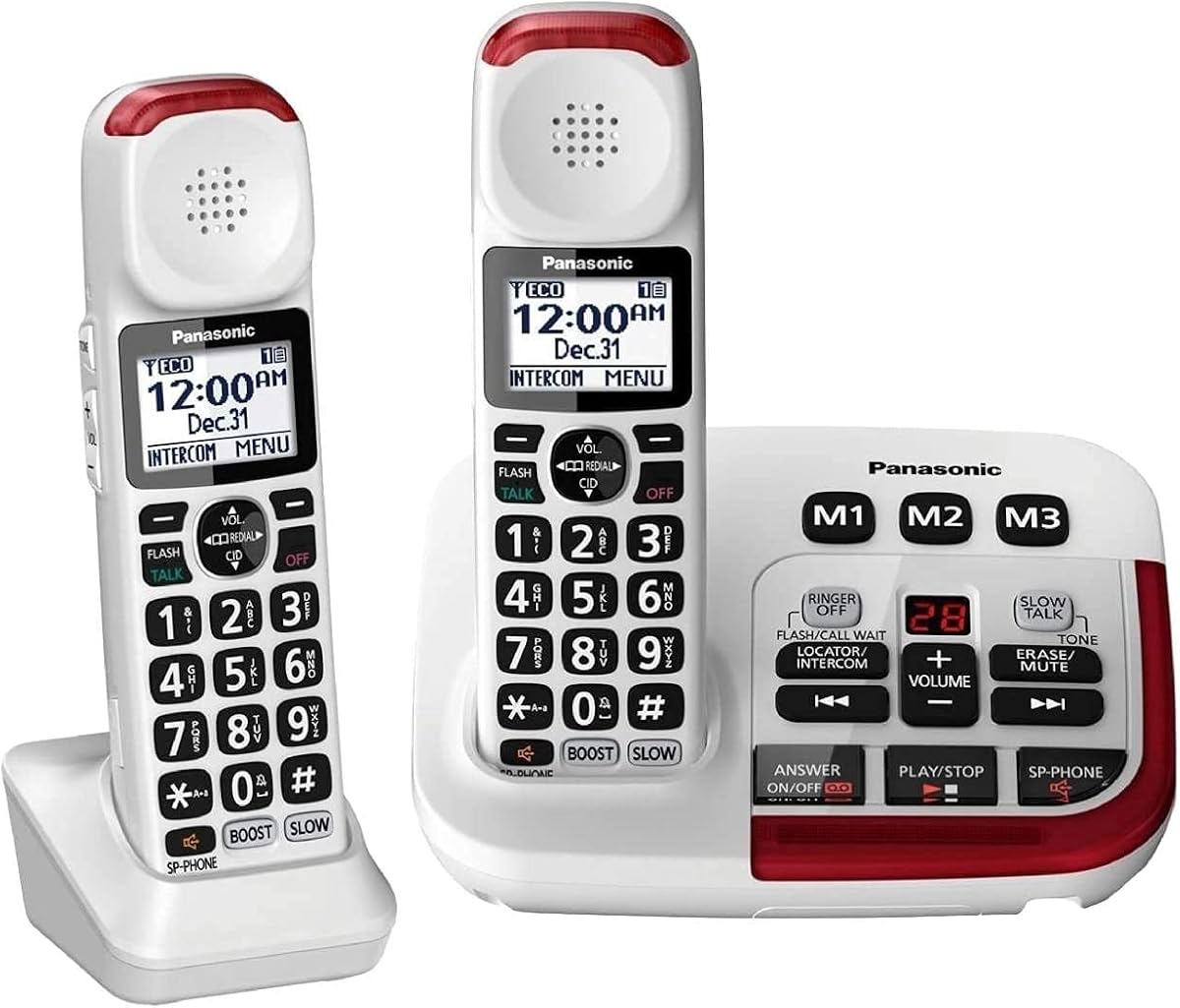
The Panasonic KX-TGM420W system is designed to amplify voice volume and boost user clarity with a 40dB volume booster. This feature ensures that callers can be heard clearly even for those with moderate hearing loss. The inclusion of noise reduction technology helps suppress background interference, making conversations more comfortable and focused on the speaker's voice.
We may earn a commission when you buy through this link, at no additional cost to you.
A unique feature of this model is the Slow Talk function, which slows down the speed of speech in real time for easier understanding. This is particularly useful for users who process speech slowly or struggle with fast conversations. The system is expandable to six handsets, allowing multiple family members to use the same line effectively without needing separate phones.
While the system offers significant audio advantages, setting up multiple handsets may require some technical steps. The need to manage several devices could be challenging for tech-averse users who prefer simplicity. However, for households with multiple individuals needing amplified sound, this scalability provides a flexible and efficient communication solution.
This model is excellent for users who need significant volume amplification and advanced audio controls. It suits families looking to expand their phone network without increasing line complexity. The combination of slow talk and noise reduction makes it a powerful tool for overcoming various listening challenges in noisy homes.
Slow Talk feature allows users to hear speech at a reduced speed for better comprehension of complex sentences.
Noise reduction technology helps filter out background sounds so users can focus on the caller's voice.
We may earn a commission when you buy through this link, at no additional cost to you.
The SWISSVOICE Big Button Phone offers a unique interface designed to simplify dialing through photo memory buttons. These buttons allow users to see who they are trying to contact, making it easier for elderly friends and relatives to stay connected. The large dialing keys display both photos and numbers, ideal for those with unsteady hands or low vision.
We may earn a commission when you buy through this link, at no additional cost to you.
This model comes with two handsets including a cordless option, providing flexibility for users who move around the home. The adjustable ringer volume can be increased up to 90dB, ensuring that incoming calls are heard clearly even if the ringer is set lower. It also includes a built-in call block feature to prevent unwanted interruptions from known numbers.
User feedback suggests mixed experiences with setup complexity and ease of use. Some users may find that the photo programming requires patience to get right compared to standard speed dial. However, once configured, the visual interface provides a significant usability advantage for those who rely on sight to make calls.
This phone is a strong option for households with visually impaired members who need visual cues for dialing. It is particularly useful for those who need multiple handsets to share across different rooms. The combination of large buttons and photo recognition makes it a thoughtful device for accessibility and ease of use.
Photo buttons display images of contacts so users can recognize who they are calling without reading small numbers.
We may earn a commission when you buy through this link, at no additional cost to you.
This Panasonic KX-TGM420W Plus package provides two handsets along with a 40dB volume boost for enhanced sound clarity. It is designed for households that require multiple points of access to the telephone line. The system is expandable to up to six handsets, making it a versatile solution for large homes where family members are spread across different rooms.
We may earn a commission when you buy through this link, at no additional cost to you.
The included digital answering machine allows users to capture and review messages at their convenience. The volume booster ensures that calls are heard clearly even in environments with background noise. With features like talk caller ID and speed dial, this system offers a comprehensive suite of tools to make calling more accessible and efficient for all users.
Managing multiple handsets requires a bit more setup effort compared to a single phone model. The cost is higher due to the inclusion of extra units, which might be a consideration for smaller households. However, for those needing widespread coverage and amplified sound, the extra units justify the investment by reducing the need to walk to a specific phone to answer a call.
This system is ideal for families where multiple people need accessible phone access throughout the home. It serves well as a central communication hub that accommodates different hearing needs simultaneously. The expandability and volume features make it a robust choice for ensuring no one in the household misses a call.
Multiple handsets allow users to keep the phone near them in various rooms like the kitchen or bedroom.
We may earn a commission when you buy through this link, at no additional cost to you.
The Amplified Landline Phone is a budget-friendly option designed to help seniors and individuals with hearing impairments stay connected. It features an extremely loud 100dB ringer that ensures no call is missed regardless of environment noise. The photo speed dial function allows users to store pictures of family members for one-touch calling, simplifying the dialing process significantly.
We may earn a commission when you buy through this link, at no additional cost to you.
Additional features include a speakerphone for hands-free conversations and compatibility with hearing aids for seamless audio transmission. The LED flashing light serves as a visual alert for incoming calls, which is helpful for those with severe hearing loss. The design includes large buttons and a sturdy build intended to withstand everyday use without issues.
While the phone offers excellent value, some users have reported issues with programming the image memory keys. This setup process may require patience and following the manual steps closely. However, once programmed, the photo dial feature provides immense convenience for users who prefer visual cues over numeric dialing sequences.
This phone is an excellent choice for those seeking a reliable and accessible phone without a high price tag. It is particularly suitable for seniors with dementia or memory issues due to the photo dial capabilities. The combination of loud alerts and visual indicators ensures that users remain connected with their loved ones easily and effectively.
Photo buttons store images of family members so users can dial simply by touching the correct picture.
The 100dB ringer and LED flash ensure calls are noticed even if the user has significant hearing impairment.
We may earn a commission when you buy through this link, at no additional cost to you.
Selecting the right telephone for hearing impairment requires careful consideration of your specific needs. The following factors will help you identify a device that offers clarity, comfort, and reliability.
Captioned telephones provide text alongside audio, which is ideal for those who need visual confirmation of words. Amplified phones focus on increasing volume levels. Determine if you need to read calls or simply hear them louder based on your hearing loss type.
If you need visual confirmation, choose captioning. If you need volume, choose amplification. Some devices combine both features for maximum clarity.
Many captioned phones rely on high-speed internet to transmit text. Ensure your home connection is stable before purchasing. Traditional amplified phones often use standard phone lines without internet dependencies.
Check your internet plan before buying captioning models. If internet is unstable, consider a standard amplified phone for reliability.
Look for devices with adjustable volume controls that fit your comfort level. Ensure the gain is sufficient for your level of hearing loss without causing discomfort. Some models offer specific gain limits like 40dB or 55dB.
Select a phone with adjustable volume. Ensure the maximum gain meets your needs without discomfort during long conversations.
Large, high-contrast buttons are essential for those with vision issues. Look for models with backlit displays and tactile feedback. Photo dial features can further simplify the dialing process for memory support.
Prioritize large buttons and clear displays. Photo dial features help if you struggle with remembering numbers or visual clarity.
Hearing aid compatibility ensures seamless integration with your existing assistive devices. Check for TIA certification and audio jacks for neckloops or headsets. This feature prevents feedback loops during calls.
Verify TIA certification for your hearing aids. Use dedicated jacks to connect accessories without feedback issues.
Flashers and strobes help ensure you do not miss calls in noisy environments. Adjustable ringers with visual indicators provide flexibility. Some models offer extra loud ringers up to 100dB for maximum notification.
Choose phones with flashers or strobes. Ensure the ringer volume is loud enough for your environment.
Features like caller ID, call blocking, and answering machines add security and convenience. Voicemail captions on some models allow for easier message review. These tools help filter unwanted calls and organize communication.
Look for caller ID and call blocking. Voicemail captions are helpful for those who need visual message reviews.
Corded phones often work during power outages, whereas cordless ones require charging. Battery backup options are valuable for critical communication lines. Consider your local power stability when choosing between corded and cordless models.
Consider corded for outage reliability. Ensure cordless models have backup batteries if power stability is a concern.
Start by setting up the device according to the manufacturer's instructions. For internet-based models, ensure the connection is active before testing calls. Check that all cables are secure and the phone is powered on.
Customize the settings to match your hearing and vision needs. Adjust volume levels, font sizes, and notification preferences. This personalization ensures the device functions optimally for your comfort.
Keep the phone and its components clean by wiping with a dry cloth. Protect the device from moisture and extreme temperatures. Regularly check cords for wear to prevent disruptions in communication.
Most modern captioned telephones require a high-speed internet connection to display real-time text. This service allows the phone to send audio to a captioning center and receive text back. Some models may offer alternative captioning methods, but internet is the standard for accuracy.
Yes, many of the models listed are designed to be hearing aid compatible. They include features like TIA certification and specific jacks for neckloops or headsets to ensure clear sound without feedback. Check the product specs for compatibility details.
Most captioning services are specifically designed for US residents due to FCC regulations. However, amplified phones without captioning services are available internationally. Always verify service availability based on your location before purchasing.
The amount of amplification needed depends on the severity of your hearing loss. Mild loss may require 20-30dB, while severe loss might need 50dB or more. Consult with a hearing specialist to determine the appropriate levels for your needs.
Many of the newer models come with smart call blockers or manual blocking features. These tools help filter out robocalls and unwanted numbers to protect your peace of mind. Check the product description for specific blocking capabilities.
If the internet connection drops, the captioning service will pause until the connection is restored. You may still hear the audio but without text. Some models have backup plans or alternative modes to ensure basic calls continue.
Most of these devices are designed to work with standard landline services. Some models may require a specific connection setup or VOIP adapter. Ensure your phone service provider supports the device before installation.
Choosing the right telephone for hearing impairment involves balancing features like captioning, amplification, and ease of use. This guide highlighted top picks ranging from budget-friendly options to advanced touchscreen models to suit various needs and budgets.
Prioritize features that address your specific challenges, whether that is loud volume or visual text support. Ensure compatibility with your home environment and any existing assistive devices. A well-chosen phone can significantly improve daily communication and quality of life.
Always verify current product availability and features before making a purchase. Specifications and services may evolve, so checking the latest information ensures you get the most suitable device. We hope this guide helps you find the perfect solution for staying connected.