
RC Cellmeter 7
4.7Editor score
Compact handheld cell checker
Supports LiPo and NiMH types
Low cost for hobbyists
This expert guide compares the top 10 Lithium Ion Battery Tester options for 2026, covering automotive, household, and specialty models for accurate diagnostics
Finding the right Lithium Ion Battery Tester ensures you maintain power systems efficiently across vehicles and devices. Modern testers offer precise diagnostics for health, charge, and charging systems to prevent unexpected failures.
We evaluated ten top-rated models based on accuracy, compatibility, ease of use, and safety features. Our analysis covers automotive load testers, household voltage checkers, and specialized capacity modules for diverse user needs.
Each pick highlights key specs, pros, cons, and ideal use cases to help you choose confidently. Note that product availability and pricing may vary over time, so verify current details before purchasing.
4.7Editor score

4.5Editor score

4.5Editor score
The following table presents a side-by-side comparison of all ten models evaluated in this guide. Each entry highlights critical specifications to assist in identifying the most suitable tester for your specific power system requirements and budget constraints.


The ANCEL BT410 stands out as a versatile tool capable of testing both lead-acid and lithium-ion batteries in 12V and 24V systems. Its high accuracy and clear display make it ideal for diagnosing complex automotive electrical issues.
We may earn a commission when you buy through this link, at no additional cost to you.
It provides detailed metrics including State of Health and State of Charge, helping users understand battery condition beyond simple voltage. The included QR report feature allows for easy sharing of data with mechanics or for personal records.
While highly capable, the tester draws power from the battery being tested, which can be tricky with very weak batteries. Additionally, the QR sharing requires a specific app, which might be an extra step for some users.
This model is best suited for vehicle owners and fleet managers needing reliable lithium and lead-acid diagnostics. Its balance of features and ease of use makes it the top recommendation for general automotive health checks.
Unlike many basic testers, the BT410 explicitly supports lithium-ion automotive batteries, ensuring you get accurate readings regardless of your vehicle's power source type.
The ability to generate a QR code with test results helps in tracking battery health over time or consulting professionals without needing to explain data verbally.
We may earn a commission when you buy through this link, at no additional cost to you.
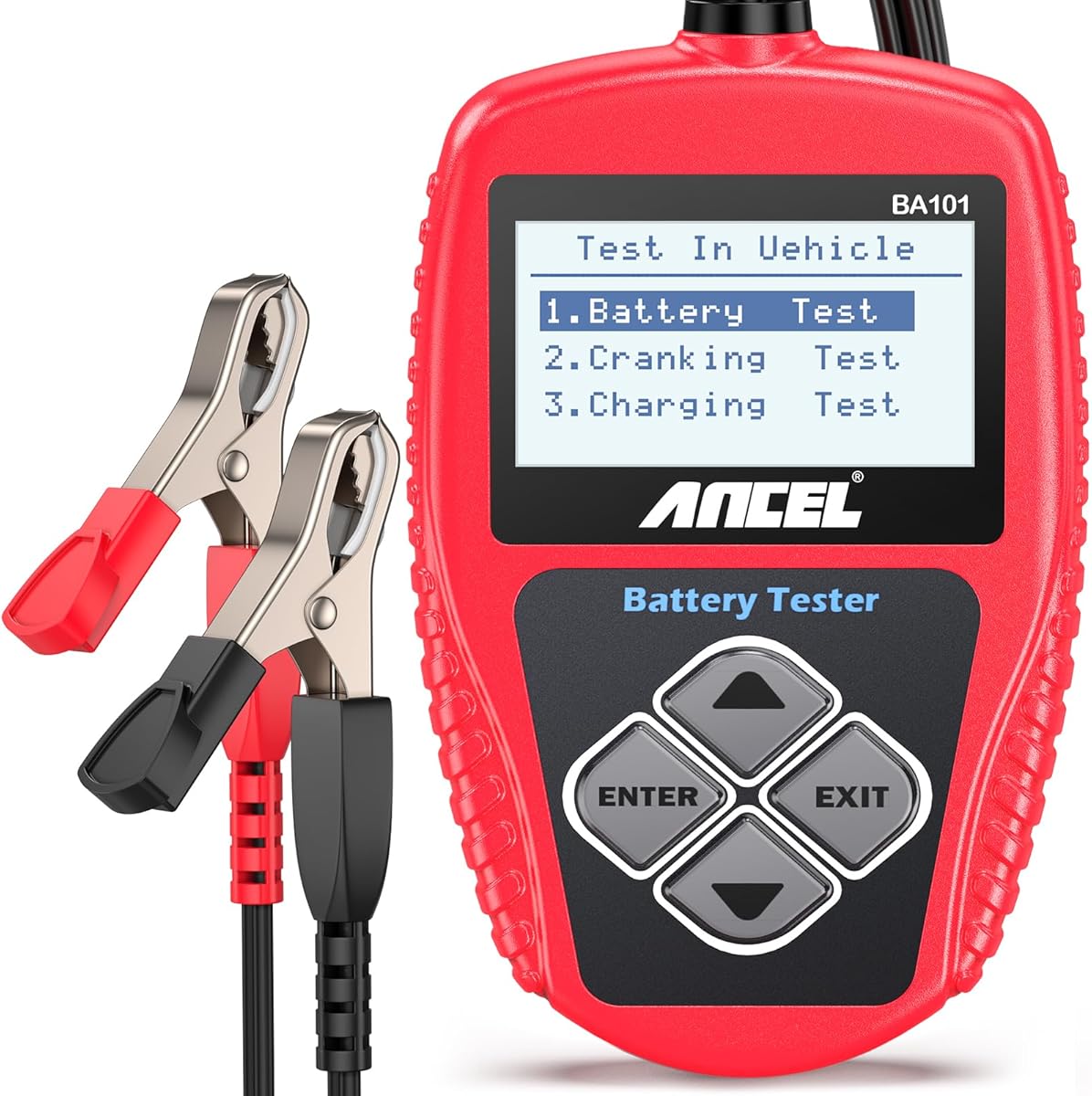
The ANCEL BA101 is a solid choice for standard 12V vehicles, offering robust diagnostics for cranking and charging systems. It is praised for its durability and clear output, making it accessible for beginners and professionals alike.
We may earn a commission when you buy through this link, at no additional cost to you.
It covers a wide range of battery standards and includes multi-language support. The reinforced ABS housing protects it during transport, and the backlight ensures visibility in dark garages during maintenance tasks.
Users should note it does not support lithium batteries, limiting its use in newer EVs or hybrid vehicles. The screen is functional but lacks color, which might reduce contrast compared to modern TFT displays.
Ideal for DIYers with traditional combustion vehicles, this tester provides essential data without complex menus. Its affordability makes it a practical addition to any home garage toolkit for routine checks.
The triple-reinforced ABS housing ensures the unit withstands drops and rough handling in a workshop environment, extending its operational lifespan significantly.
Available in multiple languages, this tool accommodates users globally, ensuring that instructions and results are understandable regardless of native language.
We may earn a commission when you buy through this link, at no additional cost to you.
This specialized module is designed for hobbyists and technicians working with 18650 lithium cells. It allows for capacity and internal resistance testing across four channels simultaneously, saving time for pack builders.
We may earn a commission when you buy through this link, at no additional cost to you.
The Type-C port simplifies power requirements, and the LCD display shows real-time voltage and current. It is particularly useful for verifying used cells before building custom battery packs for projects.
However, users may need to consult external resources for setup instructions as manuals are sometimes provided via vendor support. Accuracy is decent but may vary slightly compared to benchtop lab equipment.
Best suited for DIY battery pack construction, this tester helps ensure cell matching for optimal performance. It is a cost-effective solution for those needing to verify capacity without expensive equipment.
Testing four cells at once significantly reduces the time required to validate batches of used lithium cells for reuse in new battery projects.
The display tracks voltage, current, and power in real time, giving you immediate feedback during discharge cycles to spot anomalies quickly.
We may earn a commission when you buy through this link, at no additional cost to you.
The BT310 distinguishes itself with a built-in review function that allows users to track battery performance over time. This historical data helps in identifying gradual decline before total failure occurs.
We may earn a commission when you buy through this link, at no additional cost to you.
Its five-way result system simplifies interpretation, guiding users to decisions like recharging or replacement without needing to interpret raw data. The silicone case offers extra protection against bumps and drops.
While it supports lithium batteries, the screen resolution is basic, which might make reading fine details difficult in bright sunlight. It relies on battery power, so very flat batteries may not start the device.
This model is excellent for fleet managers who need to monitor multiple vehicles. The ability to compare past and current tests provides actionable insights for maintenance planning and cost saving.
Storing previous test data allows you to plot battery degradation trends, helping you decide the optimal time to replace a battery before it fails.
The five-way result system breaks down complex metrics into clear actionable steps, removing the guesswork for users without technical training.
We may earn a commission when you buy through this link, at no additional cost to you.
Known for its small size, the TOPDON BT100 is designed for easy storage in a glove box or center console. It provides essential health and charging tests for standard 12V batteries.
We may earn a commission when you buy through this link, at no additional cost to you.
Its use of colored LEDs allows for quick visual interpretation of results without needing to read a screen. The passive power approach ensures it is ready whenever needed without recharging.
It does not support lithium or 24V systems, which limits its utility for modern hybrids or heavy trucks. Users looking for detailed data might find the menu system less descriptive than larger units.
This is the ideal choice for casual drivers who need a quick check before a road trip. Its simplicity and portability make it a reliable companion for everyday vehicle safety.
Color-coded LEDs provide immediate status updates, allowing you to assess battery health quickly without navigating complex menus.
The compact form factor ensures it fits easily in tight spaces, keeping you prepared for unexpected battery issues on the road.
We may earn a commission when you buy through this link, at no additional cost to you.
The RC Cellmeter 7 is a favorite among drone and RC hobbyists for checking cell balance and voltage. It is compact enough to keep in a toolbox and provides clear readings for multiple chemistries.
We may earn a commission when you buy through this link, at no additional cost to you.
It supports NiMH, LiPo, and Li-ion batteries, offering broad compatibility for remote control devices. Its simple interface makes it easy to check battery safety before flight or operation.
However, it is a basic tool focused on voltage and capacity percent without detailed health metrics. The housing is plastic, which may feel less durable than ruggedized automotive testers.
This is the best value for hobbyists needing frequent checks for drones and cars. Its low cost and effectiveness make it an essential tool for anyone maintaining rechargeable RC batteries.
Compatible with NiMH, LiPo, and Li-ion cells, this meter covers the most common battery types used in RC hobbies and small electronics.
By monitoring cell voltage gap and total voltage, it helps identify unbalanced packs that could be dangerous during high discharge usage.
We may earn a commission when you buy through this link, at no additional cost to you.
The FOXWELL BT705 features a long cable that allows a single user to start the car and view results simultaneously. This makes it highly efficient for technicians working alone in a garage.
We may earn a commission when you buy through this link, at no additional cost to you.
It offers guided testing prompts that simplify the diagnostic process for beginners. The unit is well built with a hard case, ensuring it remains organized and protected between jobs.
It does not support lithium batteries, limiting use to standard lead-acid systems. The higher price point might be a barrier for casual users who do not need professional features.
Best for mechanics and serious DIYers, this tester saves time with its long cable and clear prompts. It ensures accurate diagnostics for fleet and commercial vehicles effectively.
The extended cable allows you to sit in the driver's seat while testing, saving time and effort for solo operators.
Clear on-screen prompts guide you through every test, reducing errors and ensuring you get the most accurate diagnostic results.
We may earn a commission when you buy through this link, at no additional cost to you.
Upgraded from the BT705, the BT705Plus delivers faster results with a color LCD and refined algorithms. It is designed for high-traffic shops requiring speed and accuracy.
We may earn a commission when you buy through this link, at no additional cost to you.
The color screen improves readability, and the advanced processor ensures precise measurements even on low-voltage batteries. It handles both 12V and 24V systems effectively.
It is a larger and more expensive tool, which may be overkill for simple home use. The complexity of its features requires learning, but the benefits are worth it for professionals.
This is the best premium option for professional mechanics and fleet managers. Its robust build and speed make it a reliable workhorse for daily diagnostics and high-volume testing.
The improved processor reduces wait times between tests, allowing technicians to service more vehicles efficiently throughout the day.
The color LCD ensures clear contrast in various lighting conditions, making it easy to read data in bright shops or dark garages.
We may earn a commission when you buy through this link, at no additional cost to you.
This unit is designed for common household batteries like AA, AAA, and 9V. It features a magnetic slot that secures batteries for one-handed testing, which is convenient for quick checks.
We may earn a commission when you buy through this link, at no additional cost to you.
The built-in rechargeable battery ensures it does not need disposable power cells. The screen shows voltage and health status clearly, making it easy to sort good from bad batteries.
It is not suitable for automotive or large lithium batteries. Users must remember to charge it occasionally via USB, though the battery life is long enough for infrequent household use.
Ideal for organizing household drawers, this tester helps identify old batteries quickly. Its ease of use and rechargeable nature make it a practical addition to any home maintenance kit.
The magnetic slider holds the battery firmly in place, allowing you to test with one hand without worrying about slipping contacts.
Rechargeable via USB-C, this tester reduces waste from disposable cells, aligning with sustainable practices for home tools.
We may earn a commission when you buy through this link, at no additional cost to you.
The La Crosse 911 uses a simple tray system where you insert the battery and slide it shut to test. This mechanical design is reliable and intuitive for all ages.
We may earn a commission when you buy through this link, at no additional cost to you.
It supports a wide range of common household cells and includes touch contacts for 9V batteries. The voltage range selector ensures you choose the right setting for your battery type.
Users may find the manual tray less convenient than spring-loaded or magnetic slots. It lacks advanced health indicators, focusing purely on voltage and strength levels.
This is a great budget option for basic home checks. Its simplicity and robust build make it a staple for households needing a reliable way to test remote control batteries.
The sliding tray mechanism ensures consistent contact every time, providing reliable results without complex digital setups.
Covering AA, AAA, C, D, and 9V, this tester handles almost every standard household battery found in common electronics.
We may earn a commission when you buy through this link, at no additional cost to you.
Selecting the right tester depends on your specific needs and the types of batteries you handle most often.
Ensure the tester supports the specific chemistry you need, such as lithium-ion, lead-acid, or NiMH. Some automotive models only work with lead-acid, while others handle modern lithium packs.
Always verify the chemistry support before purchasing to avoid wasting money on a device that cannot test your specific battery type.
Check whether the device supports 12V only or both 12V and 24V systems. If you own trucks or RVs, a dual voltage tester is essential for accurate results across all vehicles.
Choose a dual voltage model if you have mixed vehicle types to ensure reliable diagnostics for every unit in your fleet.
Look for testers with advanced smart chips that promise high accuracy. Precision is vital for detecting subtle resistance changes that indicate a weak battery before it fails.
Prioritize models with proven accuracy ratings to ensure you get reliable data for critical maintenance decisions.
A clear display is crucial for viewing results in various lighting conditions. Color LCDs or TFT screens often offer better contrast than basic monochrome displays.
Select a tester with a backlight or color screen to ensure readability in dark garages or bright sunlight.
For automotive testing, long cables allow you to connect clamps to batteries while viewing results from the driver's seat. A length of at least 5 to 8 feet is often recommended.
Choose longer cables to increase flexibility and convenience during one-person testing sessions.
Safety is paramount when dealing with electrical systems. Look for reverse polarity protection and short-circuit protection to prevent damage to the tester and vehicle.
Always prioritize models with built-in safety protections to avoid accidents during testing.
Some testers allow you to store test history to track battery health over time. This feature is useful for long-term maintenance and identifying gradual degradation.
Consider models with data storage if you need to monitor trends in battery performance across multiple tests.
User-friendly interfaces with guided prompts simplify the testing process. Avoid complex setups that require manual configuration for every test unless you are a professional.
Select a tester with intuitive controls to ensure quick and efficient testing without frustration.
Before testing, clean the battery terminals to remove corrosion that could interfere with accurate readings. Ensure the tester is set to the correct battery type and voltage range.
Connect the clamps securely, observing polarity. If testing a car, run the engine during cranking checks to capture live alternator performance data accurately.
Store the unit in a protective case away from moisture and extreme temperatures. Regularly clean the clamps and check the internal battery for rechargeable models to ensure longevity.
Not all lead-acid testers are compatible with lithium-ion batteries. Always check the product specifications to confirm support for lithium chemistries before purchasing.
Most automotive testers work on 12V auxiliary batteries found in hybrids. However, high-voltage battery packs require specialized professional equipment.
High-quality testers offer accuracy within 1% to 2% due to smart chips. This precision is crucial for avoiding unnecessary replacements and saving money.
A weak battery may pass voltage tests but fail load tests. This indicates it cannot sustain high current demands during engine cranking.
No, most modern testers are designed to test the battery while it remains connected to the vehicle. This allows for testing the alternator and cranking system effectively.
State of Health is a metric that indicates the overall condition of the battery relative to its original capacity. A lower SOH suggests the battery is nearing the end of its life.
Yes, most testers include safety features like reverse polarity protection. Always follow the manufacturer's instructions and wear eye protection when working with batteries.
Many advanced models include a charging system test that checks for proper alternator output. This helps distinguish between a failing battery and a bad alternator.
We have reviewed ten distinct models ranging from specialized capacity checkers to full automotive diagnostic tools. Each option offers unique strengths for different needs.
Prioritize models that explicitly support your required battery chemistry to ensure accurate readings. Compatibility is the most critical factor for reliable testing.
Always check current pricing and availability before purchasing to ensure you get the best deal. Prices fluctuate over time, so comparing offers is recommended.