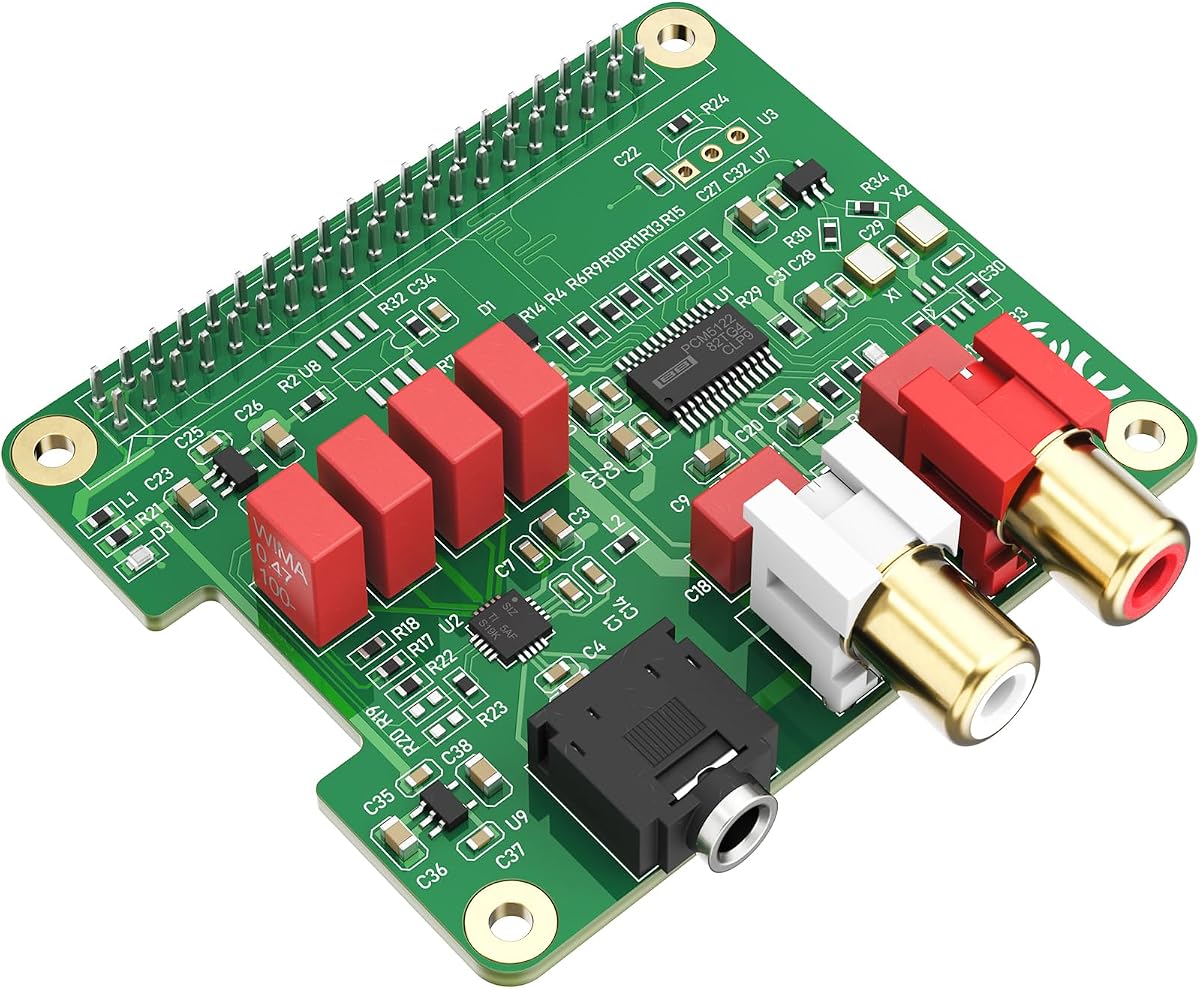
HiFi DAC HAT
4.5Editor score
PCM5122 384kHz DAC
Dual oscillators for jitter reduction
RCA and 3.5mm outputs
Discover the top DAC for Raspberry Pi options for high-res audio. We compare features, compatibility, and sound quality to help you choose the perfect HAT.
Choosing the right DAC for Raspberry Pi transforms your project into a high-fidelity audio powerhouse. These expansion boards bypass the Pi's weak onboard sound, delivering crisp, detailed audio for music lovers and audiophiles alike.
Our team evaluated ten top-rated models based on audio performance, software compatibility, and build quality. We looked at chipsets, output options, and user reviews to ensure every pick offers genuine value for your setup.
Each entry below details specific strengths and ideal use cases for different budgets. Prices fluctuate regularly on Amazon, so verify current listings before purchasing to ensure you get the best deal available today.
4.5Editor score

4.5Editor score

4.1Editor score
This side-by-side comparison highlights the key specifications and features across all ten selected digital-to-analog converters to help you quickly identify the model that best fits your specific audio project needs.


The HiFi DAC HAT stands out as the premier budget option for Raspberry Pi audio enthusiasts. With a 4.5-star rating, it delivers reference-class audio engineering at a fraction of the cost of traditional setups. It integrates seamlessly via GPIO without soldering.
We may earn a commission when you buy through this link, at no additional cost to you.
Its core strength lies in the TI PCM5122 DAC, paired with dual ultra-low jitter oscillators for precise sample rates. The board supports high-resolution audio up to 384kHz/32bit and offers versatile connectivity with RCA and 3.5mm outputs. Onboard EEPROM ensures easy configuration across various OS platforms.
While it lacks premium features like balanced XLR outputs, the trade-off is acceptable given the price. The independent grounding for outputs minimizes crosstalk effectively. Most users find the sound quality surpasses USB alternatives significantly.
This HAT is ideal for hobbyists building media centers or retro gaming consoles. It works flawlessly with Volumio and Moode. If you need studio-grade sound without breaking the bank, this remains the top recommendation in its class.
The dual oscillators provide master-clock mode to eliminate Raspberry Pi jitter, ensuring crystal clear audio reproduction.
Both RCA line-level outputs and a dedicated headphone amp allow you to drive various speakers and headphones effortlessly.
We may earn a commission when you buy through this link, at no additional cost to you.
The DAC Mini Hat is specifically engineered for users utilizing smaller Raspberry Pi Zero boards. Despite its compact form, it maintains full compatibility with larger models like the Pi 5 and 4. It delivers audiophile-grade sound quality that challenges more expensive standalone DACs.
We may earn a commission when you buy through this link, at no additional cost to you.
Equipped with the PCM5122 DAC and TPA6133 amplifier, this board ensures powerful and clean output. The gold-plated outputs provide reliable connections for your audio equipment. It supports major software ecosystems like Volumio, OSMC, and standard Pi OS.
Users appreciate its ability to fit without overhanging on Zero boards, which is a common issue with standard HATs. The sound quality is clean with minimal distortion. However, some users might prefer a slightly more premium build feel for outdoor projects.
This model is perfect for space-constrained projects like portable speakers or handheld consoles. Its affordability and targeted design make it a strong contender for DIY audio enthusiasts looking for a reliable compact solution.
Specifically designed to fit perfectly onto the Raspberry Pi Zero without overhanging for a clean, professional look.
Delivers 2.1Vrms output for driving headphones powerfully and cleanly with very low distortion levels.
We may earn a commission when you buy through this link, at no additional cost to you.
The HiFi DAC Pro Hat offers a significant jump in audio fidelity thanks to the flagship ESS ES9038Q2M converter. It is designed for true studio-quality, bit-perfect sound with support for DSD512. This makes it a top choice for serious audiophiles.
We may earn a commission when you buy through this link, at no additional cost to you.
Independent oscillators eliminate timing jitter effectively, ensuring pristine reproduction of music files. The board drives outputs with three Texas Instruments op-amps for robust power. Balanced outputs allow for professional audio equipment connections.
While the price is higher than entry-level options, the performance justifies the cost. It requires careful integration due to size but fits standard headers easily. Documentation is comprehensive via the provided Wiki.
Buyers should choose this if they prioritize maximum resolution and dynamic range. It excels in critical listening environments and home audio setups where sound quality is the primary concern over budget constraints.
Engineered with the flagship ESS converter delivering unparalleled audio experience with 129dB DNR and -120dB THD+N.
Provides balanced outputs ideal for headphones and professional audio equipment requiring differential signal transmission.
We may earn a commission when you buy through this link, at no additional cost to you.
The Digi One Hat distinguishes itself by focusing purely on digital outputs. It provides S/PDIF interfaces with optical and electric connectors. Its galvanic isolation ensures that digital signals are completely separated from the Pi's noisy power supply.
We may earn a commission when you buy through this link, at no additional cost to you.
This isolation results in cleaner audio signals when sent to external DACs or receivers. The board supports high sampling rates and is compatible with all major music player systems. It uses low jitter external oscillators for clock accuracy.
Because it is digital-only, users must have an external amplifier or DAC unit. However, for those who want to use their Pi as a transport for high-end systems, this is an ideal choice. The isolation prevents ground loops effectively.
This device is best suited for advanced users building home theater or high-fidelity systems. It acts as a perfect bridge between the Pi and external audio gear without compromising signal integrity.
Provides complete galvanic isolation of power and digital signals from the Raspberry Pi for better output signal quality.
Offers both Optical TOSLINK and electric RCA bitperfect outputs to match various receiver or DAC inputs.
We may earn a commission when you buy through this link, at no additional cost to you.
This module is designed for straightforward audio expansion with visual feedback. The red and green LEDs provide clear status of power and working conditions. It uses the reliable PCM5122 chip for 384kHz resolution and supports 16-32bit depth.
We may earn a commission when you buy through this link, at no additional cost to you.
The infrared receiver port allows for remote control integration directly on the board. This makes it easy to manage playback without accessing a keyboard. It supports Volumio and XBMC systems for flexible media center use.
The high dynamic range ensures clean audio even at low volumes. While it is an older design, it remains a top performer for basic needs. Users appreciate the simple setup and reliable operation.
Ideal for retro gaming systems or basic media players, this module offers great value. Its visual indicators help troubleshoot connection issues quickly without technical tools.
Provides LED indicators for power and decode status to better understand the working state of the DAC.
Includes an infrared receiver interface for easy remote control integration with your audio projects.
We may earn a commission when you buy through this link, at no additional cost to you.
RASPIAUDIO focuses on simplicity and reliability with its Audio+V3 HAT. The included EEPROM chip ensures plug and play functionality across all Pi versions without driver installations. It offers a clean stereo output for headphones and line level.
We may earn a commission when you buy through this link, at no additional cost to you.
The board supports up to 384kHz sampling with a 112dB signal to noise ratio. Users appreciate the aesthetic PCB design which adds a professional touch to projects. It works reliably with standard OS installations.
While it lacks advanced DSP features, it is robust and easy to use. The build quality is solid for its price range. It is a dependable choice for general music streaming tasks.
This product is best for users who want a hassle-free setup. It works well for simple speaker systems or connecting to existing amplifiers without complex configurations.
No need to install drivers thanks to the new EEPROM chip which makes setup truly plug and play.
Works with Raspberry Pi 5, 4, Zero v2, and earlier versions ensuring broad usability across projects.
We may earn a commission when you buy through this link, at no additional cost to you.
The Argon BLSTR DAC is designed specifically for the Raspberry Pi 5, offering optimized performance for the latest hardware. It includes a ground loop isolator to prevent unwanted noise and hum in the audio output. This ensures high fidelity sound.
We may earn a commission when you buy through this link, at no additional cost to you.
It uses the trusted PCM5122 codec to deliver clear audio. The installation is straightforward, making it accessible for hobbyists and professionals alike. Users have given it a perfect 5.0 rating for its reliability.
The inclusion of the isolator is a significant advantage for systems with electrical interference. It enhances audio clarity significantly. While it is limited to the Pi 5, it delivers premium results within that scope.
Ideal for users upgrading to the Pi 5 for audio duties, this HAT ensures a clean signal path. It is the recommended companion for noise-sensitive audio environments.
Enhance audio clarity with included Ground Loop Isolator to help prevent the transmission of unwanted noise or hum.
Designed to be the perfect companion for Raspberry Pi 5 owners looking for premium audio performance.
We may earn a commission when you buy through this link, at no additional cost to you.
The HiFiBerry DAC+ DSP is a powerhouse for audio customization. It features a 300MHz Digital Signal Processor capable of running thousands of instructions per sample. This allows for room equalization and sample rate conversion on the fly.
We may earn a commission when you buy through this link, at no additional cost to you.
Unlike standard DACs, this board allows you to manage DSP parameters without needing a PC. The onboard EEPROM lets it boot without the Pi for standalone use. It is ideal for complex setups with active speakers.
However, it requires a specific enclosure which may limit flexibility. The DSP features demand some technical knowledge to utilize fully. But for those who want to tweak every aspect of sound, it is unmatched.
This product is best for advanced users building custom home audio or car audio systems. It transforms the Pi into a professional DSP unit with extensive control capabilities.
High quality asynchronous sample rate converter that can upsample/downsample/mix audio sources managed by the DSP.
Onboard EEPROM allows the board to boot and run even without the Raspberry Pi for standalone DAC use.
We may earn a commission when you buy through this link, at no additional cost to you.
The HiFiBerry Digi+ Standard is a specialized digital sound card for older Pi 2 models. It supports up to 192kHz/24bit resolution via Toslink and coaxial connectors. It delivers a bit-perfect stream that does not modify audio data.
We may earn a commission when you buy through this link, at no additional cost to you.
This makes it perfect for users who have external DACs and want the Pi to handle only decoding. The dedicated chip ensures high fidelity transmission of digital signals. It is a robust option for legacy hardware.
While limited to Pi 2 models, it performs exceptionally well within its scope. Users appreciate the simplicity and reliability of digital outputs. It avoids analog conversion noise completely.
Ideal for retrofitting older setups with high-end digital audio, this card ensures your music stream stays untouched. It is a classic choice for transport duties.
Optical (Toslink) and electrical outputs ensure audio data stream will not be modified in any way.
Dedicated S/PDIF interface chip supports up to 192kHz/24bit resolution for high quality digital audio.
We may earn a commission when you buy through this link, at no additional cost to you.
The HiLetgo PCM5102 module offers a super affordable entry point into high-quality audio. It uses the PCM5102A DAC which works well with the Pi's I2S interface. Users find it sounds much better than the onboard analog audio immediately.
We may earn a commission when you buy through this link, at no additional cost to you.
The stereo jack comes soldered onto the board which simplifies assembly. It is a bare module ideal for learning or simple projects. Despite its low price, it delivers lossless digital audio conversion.
Because it is a bare module, it requires some manual integration compared to full HATs. However, this flexibility allows for custom enclosures. It is a popular choice for makers building custom audio boxes.
This is the best choice for hobbyists on a tight budget who want better than stock audio. It provides excellent performance for voice projects or basic music playback with minimal investment.
The stereo jack comes soldered onto the board already to simplify the physical build process.
Since it's digital audio, it sounds really good and much better than the onboard analog audio options.
We may earn a commission when you buy through this link, at no additional cost to you.
Selecting the right digital-to-analog converter involves balancing performance, compatibility, and features. We break down the critical factors you must consider to make the best choice for your specific project.
The DAC chipset determines the fidelity and clarity of your audio output. Look for reputable chips like PCM5122, PCM5102, or ES9038Q2M for better signal-to-noise ratios. Higher-end chips offer better dynamic range and lower distortion levels.
Prioritize chips with higher resolution support like 32-bit/384kHz for high-quality streaming.
Consider what devices you need to connect. RCA outputs are best for amplifiers while 3.5mm is ideal for headphones. Some boards offer balanced XLR outputs for professional setups requiring interference rejection.
Match the output type to your existing audio system components for seamless integration.
Ensure the HAT works with your chosen music server software. Most modern DACs support Volumio, Moode, and PiCorePlayer. Check for EEPROM support to enable plug and play functionality without manual configuration.
Choose a board with strong community support and documentation for easier troubleshooting.
Verify that the HAT fits your specific Pi model. While most use 40-pin headers, smaller boards like Zero require compact designs. Ensure there is no interference with other GPIO pins or ports you intend to use.
Check the physical dimensions to avoid overhanging on smaller boards like the Zero series.
Jitter can degrade audio timing and clarity. Look for boards that include external oscillators or master-clock modes to reduce jitter from the Pi's internal clock. This is crucial for high-resolution audio playback.
Prioritize boards with external crystal oscillators for the most precise sample rates.
Digital boards like S/PDIF allow you to send audio to an external DAC while analog boards convert internally. Digital options are better for advanced setups needing flexible routing. Analog options are simpler for direct speaker connections.
Select digital outputs if you want to upgrade your DAC independently in the future.
Ground loops can cause hum in your audio. Boards with galvanic or power isolation prevent electrical noise from the Pi affecting the signal. This is vital for clean sound in electrically noisy environments.
Look for isolation features if you experience noise hum in your current setup.
Sturdy build quality ensures longevity and reliable electrical connections. Gold-plated contacts resist corrosion and improve signal quality. A well-organized PCB helps manage heat and interference effectively.
Prioritize boards with robust construction and clear labeling for long-term reliability.
Start by installing the HAT firmly onto the GPIO pins. Ensure no pins are bent and the board is seated evenly. Connect your audio cables to the output jacks securely.
Configure your software to recognize the DAC. On most systems, this involves enabling I2S in raspi-config or selecting the audio output in your media player. Reboot the system to apply changes.
Avoid static electricity when handling the board. Store it in a dry environment when not in use to prevent moisture damage. Regularly check connections to ensure they remain tight and secure.
No, most modern HATs are designed for plug and play connectivity directly to the GPIO pins without any soldering. However, some bare modules might require headers to be soldered for secure mounting.
Ground loops or insufficient power isolation often cause audio noise. Using a HAT with galvanic isolation or adding a ground loop isolator can resolve this issue effectively.
Yes, but you must choose a compact design like the DAC Mini Hat to ensure it fits without overhanging on the smaller board.
I2S is a digital audio interface protocol that the Pi uses to transmit high-quality sound data to the DAC for conversion into analog signals.
Yes, most top-rated DACs list Volumio as a primary supported software platform for easy configuration and playback.
If you use RCA outputs, you need an external amplifier or speakers with built-in amps. Some DACs include headphone amps for direct headphone connection without extra gear.
Usually you enable I2S via raspi-config or select the device in your audio player settings. Some HATs with EEPROM are detected automatically.
HAT stands for Hardware Attached on Top. It is an expansion board that connects to the GPIO pins of the Raspberry Pi to add new functionality like audio.
We have reviewed ten top-performing DACs for the Raspberry Pi ranging from budget-friendly HATs to premium DSP solutions. The HiFi DAC HAT offers the best value while the HiFi DAC Pro Hat excels in high-resolution fidelity.
Prioritize compatibility with your specific Pi model and your preferred software platform. If you need a compact board for a Zero, look for tailored designs. For audiophile setups, focus on jitter reduction and isolation.
Remember that prices change frequently on Amazon so check current listings before purchasing. With the right DAC you can transform your Pi into a world-class audio system for music streaming.