
SEESII Dual Channel 30MHz DDS Signal Generator
5.0Editor score
30 MHz frequency range
14-bit resolution accuracy
Independent dual channels
This guide compares the top Amfm Signal Generator options for professionals and hobbyists evaluating performance features and reliability for electronic
Finding the right Amfm Signal Generator is essential for anyone working with electronic circuits radio systems or communication equipment. A quality unit delivers precise signals needed for testing debugging and maintaining hardware across various industries and applications effectively.
We evaluated ten leading models based on frequency range modulation types output stability and user interface design. Each product was assessed for its ability to handle diverse testing scenarios from basic troubleshooting to advanced research and development tasks.
Every pick in this list highlights specific strengths and ideal use cases to help you match the tool to your needs. Keep in mind that product availability and pricing can change so always verify current details before making your final purchase decision.
5.0Editor score

5.0Editor score

4.2Editor score
The following table provides a side-by-side comparison of all ten models highlighting key specifications and features to help you quickly identify the most suitable option for your specific testing requirements.




The UNI-T UTG962E stands out as a top-tier Amfm Signal Generator offering professional performance in a handheld form factor. With a perfect rating from users it delivers reliable and precise signal generation suitable for both field work and lab environments.
We may earn a commission when you buy through this link, at no additional cost to you.
Its 60 MHz dual-channel output combined with a 200 MS/s sample rate ensures high-fidelity waveform production. The inclusion of AM FM PM and FSK modulation types provides the versatility needed for testing communication circuits radio equipment and digital systems without needing multiple devices.
While the compact size is a major advantage for portability the small display can make navigating complex settings slightly challenging. Additionally the price point may be higher than entry-level options but the performance justifies the investment for serious technicians.
This generator is ideal for electronics enthusiasts and professionals who require a robust portable tool for diverse testing needs. The built-in scan functionality and arbitrary waveform storage further enhance its utility for advanced troubleshooting and system validation.
Support for AM FM PM and FSK modulation allows users to test various communication protocols and signal behaviors accurately within a single device.
A 200 MS/s sample rate ensures that even complex waveforms are generated with minimal distortion for accurate results in sensitive circuits.
We may earn a commission when you buy through this link, at no additional cost to you.
The OWON DGE2035 combines high precision with user-friendly design making it a standout choice for engineers and educators. Its strong rating reflects consistent performance in generating stable and accurate signals for detailed electronic analysis.
We may earn a commission when you buy through this link, at no additional cost to you.
Featuring 14-bit resolution and a 125 MSa/s sampling rate this generator excels at producing clean and reliable waveforms. The 3.6 TFT LCD screen provides clear visual feedback for adjustments and the PC control capability allows for automated testing workflows in lab settings.
Some users note that the 35 MHz frequency is lower than some competing models which may limit use in very high-frequency applications. Additionally using PC control requires initial setup which can add time to the testing process for quick on-site checks.
This device is best suited for research labs and educational environments where precision and remote control are prioritized. The included arbitrary waveforms and modulation features make it a comprehensive tool for complex signal simulation and circuit debugging.
The 14-bit resolution ensures minimal distortion in generated signals which is critical for testing high-fidelity audio and sensitive analog circuits.
Remote control via USB enables users to script tests and automate signal generation for repetitive or complex validation tasks efficiently.
We may earn a commission when you buy through this link, at no additional cost to you.
The SEESII Dual Channel 30MHz DDS Signal Generator offers exceptional value for users seeking dual-channel capability without a high price tag. Its perfect user rating highlights reliable performance and ease of use for a wide range of electronics projects.
We may earn a commission when you buy through this link, at no additional cost to you.
With a 30 MHz frequency range and 14-bit resolution this unit delivers precise signals suitable for testing audio circuits microcontrollers and low-frequency RF systems. The fully independent dual channels allow for phase-adjustable outputs which is useful for differential circuit testing.
Unlike some competitors it does not include built-in AM FM modulation which may be a limitation for radio testing. However the 30 MHz limit is sufficient for many hobbyist and educational applications where cost and channel count are primary concerns.
This generator is an excellent choice for students engineers and hobbyists needing a versatile and budget-friendly tool. The included accessories and clear display make it easy to start using right away for immediate testing and development work.
Each channel operates independently with adjustable phase difference enabling precise testing of differential and synchronous circuits without external gear.
Sixty built-in arbitrary waveforms cover most simulation needs reducing the time required to create custom signal patterns for testing.
We may earn a commission when you buy through this link, at no additional cost to you.
This 6-Band Signal Generator is tailored for radio and RF equipment maintenance with a wide frequency range and low phase noise performance. Its sturdy construction and straightforward design make it a practical tool for technicians who need reliable RF signal sources.
We may earn a commission when you buy through this link, at no additional cost to you.
The unit covers 100KHz to 150MHz across six distinct bands allowing users to target specific frequency ranges for calibration and testing. AM and FM modulation capabilities are included to simulate broadcast signals which is useful for evaluating radio receivers and antennas.
While it lacks the digital arbitrary waveform features of higher-end models its simplicity ensures quick setup and operation. The metal casing provides durability in workshop environments though the analog-style controls may feel dated compared to modern digital interfaces.
Ideal for field technicians and radio hobbyists this generator delivers focused functionality without unnecessary complexity. The low phase noise characteristic ensures clean signals which are essential for accurate RF testing and minimal interference during maintenance tasks.
Minimized phase noise keeps signals clean which reduces errors when testing sensitive radio equipment and ensures accurate calibration results.
A sturdy metal and plastic build ensures the device withstands frequent use and transport in professional maintenance environments.
We may earn a commission when you buy through this link, at no additional cost to you.
The Upgraded RF Signal Generator SG-A9 offers an exceptionally wide frequency range that extends into microwave territory making it unique among affordable options. Its lower rating suggests some variability in performance but it remains a niche tool for broadband RF applications.
We may earn a commission when you buy through this link, at no additional cost to you.
Covering 35MHz to 4400MHz this device is suitable for testing a broad array of wireless components and communication modules. The ability to switch between single frequency and sweep modes adds flexibility for scanning and identifying signal responses across the spectrum.
However the unit outputs only sine waves without modulation support which limits its use to simple signal injection tasks. Power consumption is low allowing use with power banks though output power is modest at about 1mw which may not suit high-gain testing.
This generator is best for users needing a budget-friendly broadband signal source for basic RF checks. Its power-off memory and portable power options make it convenient for field use where flexibility and range are more critical than advanced modulation.
The 35MHz to 4400MHz range supports testing of Wi-Fi Bluetooth and other wireless modules that operate at higher frequencies.
Sweep functionality allows users to scan across frequencies quickly which helps in identifying resonant points or signal blocks.
We may earn a commission when you buy through this link, at no additional cost to you.
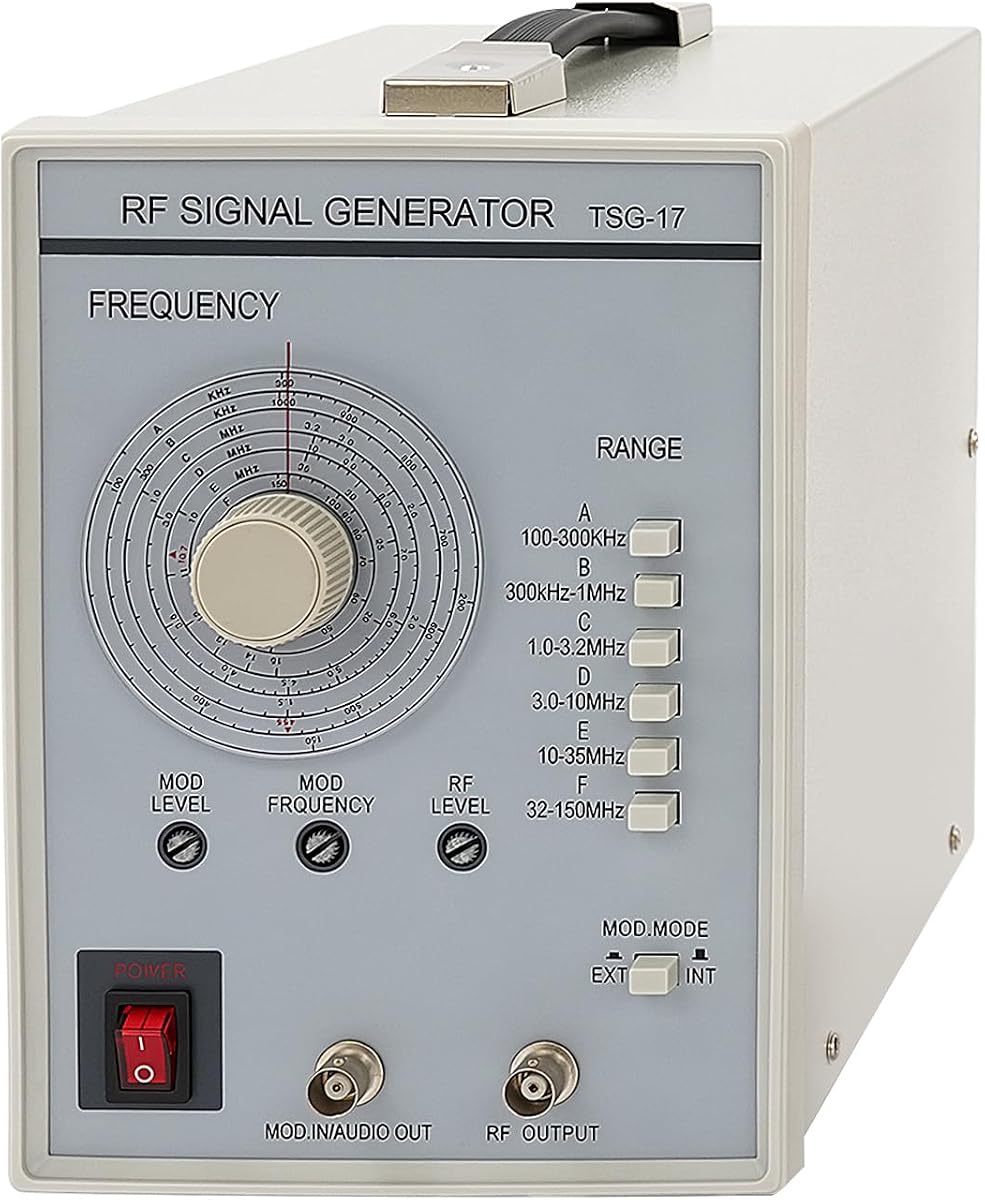
The TSG-17 High Frequency RF/AM Radio Frequency Signal Generator is designed for commercial and household maintenance tasks requiring stable AM signals. Its lower user rating indicates mixed performance experiences but it offers specific features useful for targeted testing scenarios.
We may earn a commission when you buy through this link, at no additional cost to you.
With a frequency range of 100kHz to 150MHz and three harmonic outputs this unit can simulate complex signal environments. The external modulation feature allows for customized signal shaping which is beneficial for specialized audio and radio receiver testing.
However the device relies on 110V power limiting its portability compared to battery-powered alternatives. Users should verify performance consistency as the low rating suggests potential variability in signal stability or build quality across units.
This generator suits commercial technicians who need an affordable AM signal source for routine checks. The wide output control range and harmonic options provide additional flexibility for troubleshooting equipment that responds to multiple signal frequencies.
The ability to generate up to three harmonics expands testing scenarios for circuits that depend on frequency multiples.
Users can apply external modulation signals to customize the output waveforms for more advanced experimental setups.
We may earn a commission when you buy through this link, at no additional cost to you.
This Adjustable Signal Generator focuses on process control signals rather than RF making it ideal for industrial automation and sensor testing. Its solid rating reflects reliable performance in simulating standard 4-20mA and voltage loops used in PLC systems.
We may earn a commission when you buy through this link, at no additional cost to you.
The device offers adjustable current and voltage outputs along with a PWM function for frequency-based testing. A built-in 1500mAh lithium battery allows for field use without constant access to wall power which is valuable for on-site maintenance technicians.
Since it is not designed for RF signal generation it does not meet the traditional Amfm Signal Generator criteria for communication testing. However for industrial controls and sensor calibration this unit provides precise and safe signal simulation with short circuit protection.
Best suited for HVAC industrial and automation professionals this generator simplifies the process of verifying control loops and device responses. The memory function ensures settings are retained for power cycles making it convenient for repeated testing tasks.
Generating standard 4-20mA and 0-12V signals helps technicians validate industrial controllers and sensors without live equipment.
The integrated battery and protection circuits allow for safe and mobile use in diverse field environments.
We may earn a commission when you buy through this link, at no additional cost to you.
The Riiai 0-10V Current Voltage Signal Generator is a compact and precise tool designed for PLC and panel debugging tasks. Its high rating indicates strong performance in delivering accurate low-voltage and current signals for industrial control testing.
We may earn a commission when you buy through this link, at no additional cost to you.
With a 4-digit display and an encoder knob for adjustment users can fine-tune outputs with high precision. The rechargeable battery and multiple power options ensure the device remains functional during extended field work or in remote locations.
This unit is not an RF generator and thus does not produce Amfm signals but excels in analog control simulation. The safety features such as short circuit and reverse connection protection make it reliable for repeated use without damaging connected devices.
Ideal for technicians working with automation systems this generator streamlines the process of calibrating and testing control interfaces. Its small size and clear display make it easy to carry and operate in tight or crowded control panels.
The 0.01V and 0.01mA resolution allows exact tuning of signals which is critical for calibrating sensitive industrial instruments.
Built-in protections guard against accidental short circuits or reverse connections protecting both the tool and the device under test.
We may earn a commission when you buy through this link, at no additional cost to you.
The Riiai SG003A expands on basic signal generation by supporting multiple signal types including current voltage and pulse outputs. Its strong rating reflects a versatile tool that serves well for testing PLCs and industrial control systems needing varied signals.
We may earn a commission when you buy through this link, at no additional cost to you.
A 3000mAh battery provides up to 26 hours of operation reducing downtime during extended testing sessions. The TFT color screen offers real-time curve displays which help users visualize signal changes and validate performance in real time.
As with other units in this category it does not provide RF modulation but is highly capable for analog and digital control testing. The programmable output modes allow automated signal variation which is useful for stress testing devices under different conditions.
This simulator is best for engineers and technicians needing a comprehensive tool for industrial control validation. The combination of display options battery life and signal variety makes it a powerful asset for complex system debugging and maintenance.
Support for current voltage and pulse signals covers most industrial testing needs without switching between multiple devices.
A 3000mAh capacity ensures the tool remains ready for long field jobs without frequent recharges or power sources.
We may earn a commission when you buy through this link, at no additional cost to you.
The DROK 4-20mA Generator offers a simple and affordable solution for basic signal simulation needs in electronics and industrial testing. Its good rating suggests reliable performance for entry-level users who need straightforward control over current and voltage signals.
We may earn a commission when you buy through this link, at no additional cost to you.
Using a multi-cycle potentiometer this unit allows fine-tuned adjustments for output values which is beneficial for precise calibration tasks. The ability to generate both current and voltage signals in one module reduces the need for separate tools in a testing workflow.
Without a digital display or programmable memory this generator relies on manual settings which may limit speed in repetitive testing. However for occasional use or budget-constrained projects the simplicity ensures the device is easy to operate without learning curves.
This generator is perfect for hobbyists and small shops needing a basic tool for LED panel or PLC testing. Its compact size and dual signal output provide essential functionality at a low price point for users new to signal simulation.
Generating both current and voltage signals in one module saves space and cost for basic industrial testing workflows.
Manual potentiometer control makes the device intuitive and accessible for users who prefer physical adjustments over digital menus.
We may earn a commission when you buy through this link, at no additional cost to you.
Selecting the right Amfm Signal Generator requires understanding key features that impact performance and usability in your specific testing environment.
The frequency range determines the types of signals your generator can produce. For RF and communication testing a higher range up to 150 MHz or more is essential. Accuracy ensures the output matches the set value which is critical for precise calibration tasks.
Prioritize units with a range that covers your highest required frequency and check frequency tolerance specifications to ensure reliable results.
Modulation types like AM FM and PM allow you to simulate real-world signal behaviors. If you are testing radio equipment or communication circuits ensure the generator supports the specific modulation schemes required for your projects.
Look for models that include multiple modulation options to increase versatility across different testing scenarios without needing additional hardware.
Dual-channel generators enable simultaneous output of independent signals which is useful for testing differential circuits or comparing responses. Single-channel units may suffice for basic tasks but dual channels offer greater flexibility.
Choose a dual-channel model if your testing involves phase relationships or synchronous signal requirements to avoid manual switching delays.
Stable output with low phase noise ensures clean signals that do not introduce errors into sensitive equipment. High noise levels can distort test results and lead to incorrect diagnoses during maintenance.
Select generators that advertise low phase noise characteristics and stable performance over time for consistent and accurate signal generation.
A clear and intuitive interface helps users set parameters quickly and view outputs easily. TFT LCD screens provide better visibility than basic displays and support more detailed settings.
Look for models with responsive controls and clear labels to streamline workflow especially when testing under time constraints or in varied lighting.
For fieldwork a compact generator with a built-in battery ensures you can test anywhere without relying on wall outlets. USB or power bank support adds to flexibility in remote locations.
Consider size weight and battery life if you plan to carry the generator frequently to ensure it suits your mobility needs.
USB or PC control enables automation and remote operation which is valuable for repetitive or complex tests. Connectivity allows integration with other equipment for seamless workflow.
Opt for models with standard USB interfaces if you plan to use software tools for advanced signal manipulation or data logging.
A sturdy construction resists damage from drops or exposure in workshop environments. Metal casings and quality materials extend the lifespan of the device under regular use.
Choose generators with robust builds and protective features to ensure long-term reliability and consistent performance over time.
Begin by connecting the generator to the device under test using appropriate cables such as BNC or alligator clips. Ensure the output impedance matches the target device to prevent signal reflection or damage.
Set the desired frequency amplitude and modulation parameters using the control panel. Verify the settings against the device requirements to ensure accurate signal simulation during testing.
After use turn off the generator and disconnect cables carefully. Store the unit in a dry place and avoid exposing it to extreme temperatures to maintain performance and longevity.
An Amfm Signal Generator creates electrical signals with amplitude or frequency modulation to test and calibrate electronic circuits radio receivers and communication equipment. It helps engineers verify device performance and troubleshoot issues in various applications.
Select a generator whose frequency range covers the highest frequency your device will encounter. For radio testing aim for models supporting at least 100 MHz or higher to ensure compatibility with modern signal bands.
Analog generators produce signals through traditional electronic circuits while digital units use microprocessors to generate precise waveforms. Digital models often offer better stability more features and easier control for complex testing needs.
Yes many Amfm Signal Generators support frequencies that overlap with wireless protocols making them useful for basic wireless device testing. Ensure the model supports the necessary range and modulation for your specific wireless technology.
Always match output impedance to the load to prevent signal reflections and avoid overloading the generator. Ensure cables are in good condition and power connections are secure to maintain safety and accurate measurements.
With proper care and regular maintenance a quality Amfm Signal Generator can last several years. Avoid exposing the unit to moisture or extreme heat and calibrate it periodically to ensure continued accuracy and reliability.
The top picks in this guide provide a range of options from professional dual-channel units to affordable simulators suited for different needs and budgets. Each model offers unique strengths that cater to specific testing environments and technical requirements.
When selecting a generator prioritize features like frequency range modulation types and build quality that match your most common use cases. Investing in the right tool can streamline your testing workflow and improve the accuracy of your results.
Remember to verify current pricing and availability before purchasing since market conditions can change. By choosing the right Amfm Signal Generator you ensure efficient and reliable testing for your electronic and RF projects.