
Bambu Lab A1
4.7Editor score
High-speed precision printing
Multi-color capability with AMS
Full-auto calibration system
Choosing the right 3D printer for Dnd miniatures requires balancing detail, speed, and ease of use. Whether you prefer resin or FDM technology, there are excellent options available today.
We compared ten leading models based on resolution, speed, material compatibility, and user feedback. This list covers everything from budget-friendly starters to high-end professional machines.
Each pick highlights key features and potential drawbacks to help you decide. Remember that prices and availability can change quickly so check current listings before buying.
4.7Editor score

4.4Editor score

4.5Editor score
As an Amazon Associate we earn from qualifying purchases.
This side-by-side comparison highlights the core specifications and capabilities of each model to help you identify the best fit for your specific gaming needs.






The Phrozen Sonic Mini 8K S stands out as a top choice for Dnd miniature printing due to its high resolution and ease of use. It offers a 22-micron XY resolution that brings out intricate details in your characters and terrain pieces.
We may earn a commission when you buy through this link, at no additional cost to you.
Its 7.1-inch monochrome LCD ensures crisp prints while the compact design fits easily on most desks. The printer supports open-source software like Lychee and Chitubox giving you flexibility in slicing and customization.
While resin printing requires safety gear and post-processing steps the detail level justifies the effort. The Z-axis calibration ensures consistent layers which is critical for small figurines.
This model is ideal for beginners who want professional-grade results without a steep learning curve. It balances price and performance perfectly for tabletop gamers.
The 22-micron resolution captures fine textures on armor and faces ensuring your miniatures look stunning on the table.
Despite its small footprint the printer offers sufficient volume for multiple figures and accessories in a single print job.
We may earn a commission when you buy through this link, at no additional cost to you.
The Bambu Lab A1 delivers exceptional speed and precision making it a budget-friendly contender for Dnd miniature projects. It features active flow rate compensation for smooth prints and full-auto calibration to reduce setup time.
We may earn a commission when you buy through this link, at no additional cost to you.
With an acceleration of 10,000 mm/s² this printer completes tasks quickly while maintaining accuracy. The user-friendly touchscreen and quick-swap nozzle make maintenance simple for all skill levels.
Although multi-color printing requires an optional AMS lite the base unit remains reliable for single-color bases. The motor noise canceling ensures a quiet workspace.
Ideal for beginners and families the A1 offers a seamless experience without hidden costs. Its reliability and speed make it a top value pick.
Enjoy fast turnaround times without sacrificing detail thanks to advanced algorithms that optimize flow and movement.
Forget manual calibration as the printer handles Z-offset and leveling automatically allowing you to start printing sooner.
We may earn a commission when you buy through this link, at no additional cost to you.
The Snapmaker U1 is a premium powerhouse for advanced users needing multi-material capabilities. Its 4-toolhead system with a 5-second changer eliminates manual swaps and reduces waste significantly.
We may earn a commission when you buy through this link, at no additional cost to you.
This machine combines rigid and flexible materials in a single print allowing for complex miniatures with soluble supports. The CoreXY system ensures stability at speeds up to 500 mm/s.
While the cost is higher the productivity gains and design freedom are unmatched. Smart calibration and AI monitoring further simplify the workflow.
For professionals or serious hobbyists this printer offers the ultimate versatility. It transforms how you approach detailed Dnd project creation.
Swap between rigid and flexible filaments instantly without purging saving time and material on complex models.
Features like AI monitoring and toolhead calibration ensure consistent quality with minimal manual intervention required.
We may earn a commission when you buy through this link, at no additional cost to you.
The Bambu Lab P2S Combo offers high-speed precision ideal for rapid Dnd terrain production. It prints up to 600 mm/s while maintaining sharp corners and consistent layers.
We may earn a commission when you buy through this link, at no additional cost to you.
The AMS 2 Pro enables seamless multi-color printing with built-in filament drying ensuring reliable results. Adaptive airflow keeps overhangs crisp regardless of material.
Setup takes just 15 minutes with AI failure detection and automatic calibration. The workflow integrates smoothly with Bambu Studio and Handy apps.
This model suits users who need speed and reliability. Its professional features make it a strong contender for serious creators.
Achieve lightning-fast prints without compromising on detail thanks to advanced servo extruders and flow compensation.
Adaptive airflow and drying capabilities allow you to work with a wide range of engineering-grade materials confidently.
We may earn a commission when you buy through this link, at no additional cost to you.
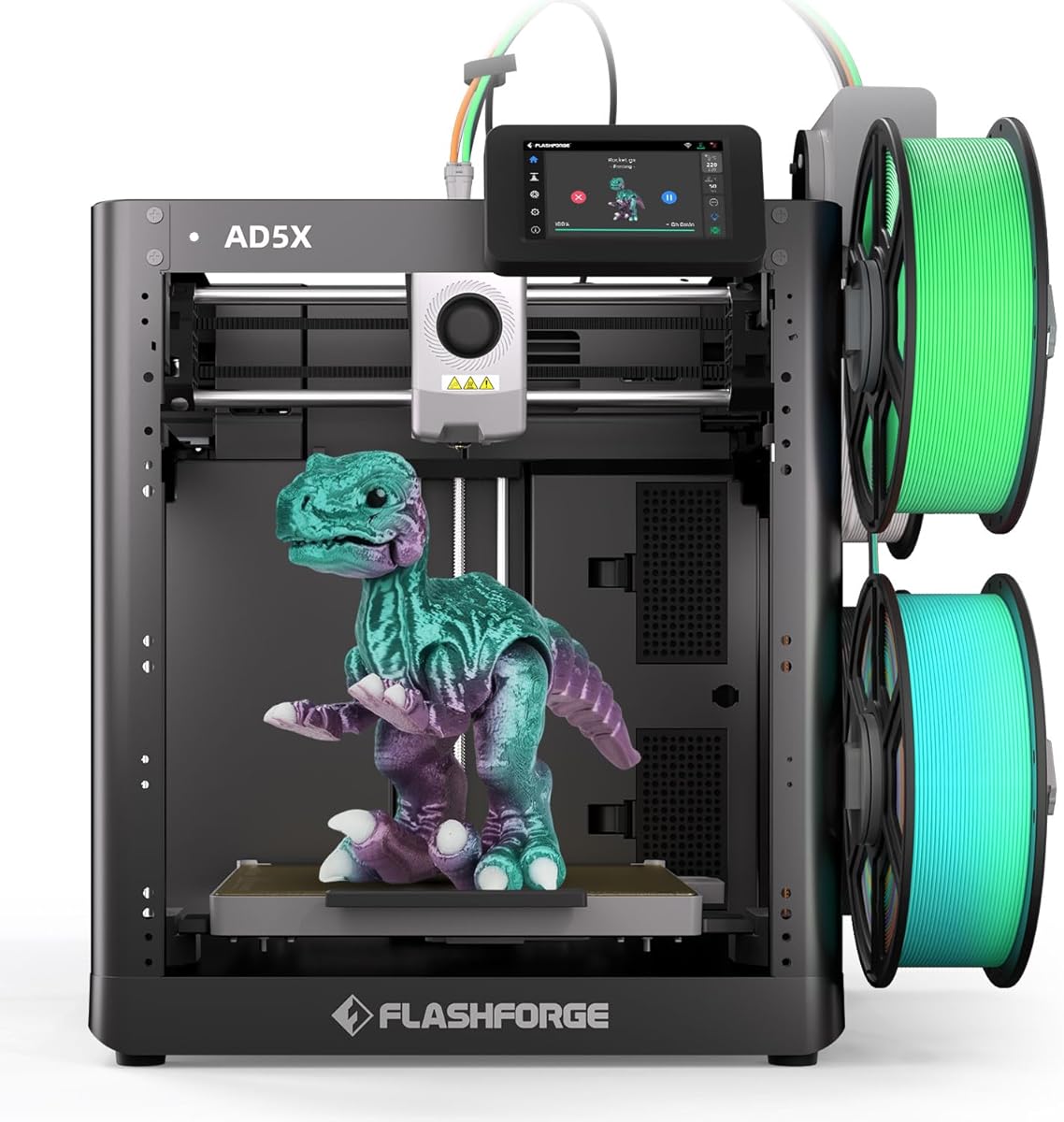
The FLASHFORGE AD5X introduces innovative multi-color printing for Dnd miniatures with four colors simultaneous. Its Intelligent Filament System minimizes downtime and ensures smooth production.
We may earn a commission when you buy through this link, at no additional cost to you.
Speed is a highlight with 600 mm/s printing and 20,000 mm/s² acceleration. The all-metal Core XY structure reduces vibrations for accurate results.
With a large build volume you can print multiple miniatures at once. The nozzle reaches 300°C supporting various material types.
This printer is great for users wanting colorful models without swapping filaments manually. It balances performance and versatility well.
Create vibrant miniatures with up to four colors at once enhancing visual appeal without extra post-processing.
The Core XY design ensures stability even at high speeds resulting in smoother surfaces and sharper details.
We may earn a commission when you buy through this link, at no additional cost to you.
The Bambu Lab P1S features an enclosed design perfect for advanced filaments and consistent results. It supports multi-color printing via AMS and reaches 500 mm/s speeds.
We may earn a commission when you buy through this link, at no additional cost to you.
Automatic bed leveling simplifies setup ensuring successful prints every time. The user-friendly design allows assembly in 15 minutes.
It handles various materials including PETG and TPU making it versatile for Dnd needs. The enclosure improves print quality for complex geometries.
Ideal for those wanting reliability and flexibility the P1S is a strong mid-to-high range choice. It balances performance with ease of use.
The enclosed body maintains stable temperatures ensuring consistent results even with sensitive engineering materials.
Enjoy rapid printing with automatic calibration reducing downtime and letting you focus on design rather than setup.
We may earn a commission when you buy through this link, at no additional cost to you.
The FLASHFORGE Adventurer 5M Pro features a 1-click auto printing system for convenience. It supports 600 mm/s speeds and vibration compensation for smooth surfaces.
We may earn a commission when you buy through this link, at no additional cost to you.
The 3-second quick-swap nozzle allows easy size changes while the dual filtration keeps the environment clean. A built-in camera enables remote monitoring.
With a 280°C extruder it handles engineering materials like ABS. The 4.3-inch touchscreen simplifies operation for all users.
This model is great for home or office use due to its quiet operation. It balances performance with user-friendly features.
Operates under 50dB while printing fast making it suitable for shared spaces without disturbing others.
High-temp extrusion supports a wide range of filaments from standard PLA to engineering-grade options.
We may earn a commission when you buy through this link, at no additional cost to you.
The FLASHFORGE AD5X Multi-Material version enhances productivity with 4-color printing and filament backup. It features IFS for precise control and 600 mm/s speeds.
We may earn a commission when you buy through this link, at no additional cost to you.
Vibration compensation algorithms ensure layer alignment is accurate even at high speeds. The Core XY structure reduces mechanical shifts during operation.
A compact design saves space while allowing multiple spool arrangements. Full-auto calibration ensures the first layer adheres evenly.
This printer is suited for those seeking efficiency and flexibility. It balances advanced features with a manageable footprint.
Filament backup and IFS minimize interruptions keeping your print jobs running smoothly with less manual attention.
Vibration suppression maintains layer integrity ensuring your miniatures look professional and consistent.
We may earn a commission when you buy through this link, at no additional cost to you.
The Bambu Lab A1 Mini Combo offers multi-color printing in a compact form. It features full-auto calibration and speeds up to 10,000 mm/s² acceleration.
We may earn a commission when you buy through this link, at no additional cost to you.
With AMS lite included you can create vibrant prints without separate purchases. The design is pre-assembled for a quick setup.
Noise cancellation keeps operation quiet at 48 dB. The quick-swap nozzle allows versatile maintenance and options.
This is ideal for smaller desks or shared spaces. It delivers high performance in a smaller package.
Despite its small size it delivers the same precision and speed as larger models in the lineup.
The included AMS lite means you can start printing colorful miniatures right out of the box.
We may earn a commission when you buy through this link, at no additional cost to you.
The Anycubic Kobra X comes with native 4-color printing built-in. It reaches 600 mm/s and features a hardened steel nozzle for durability.
We may earn a commission when you buy through this link, at no additional cost to you.
LeviQ 3.0 leveling ensures bed flatness for perfect first layers. AI monitoring and remote control via Wi-Fi add convenience.
A vast model library helps beginners get started quickly. It supports mixed materials for versatile printing options.
This printer suits home users wanting colorful prints without complex setups. It balances speed and ease effectively.
Built-in color support reduces complexity allowing you to create vibrant miniatures with minimal setup.
Dual-band Wi-Fi and remote control let you manage prints from anywhere adding flexibility to your workflow.
We may earn a commission when you buy through this link, at no additional cost to you.
Selecting the right 3D printer involves evaluating technology type resolution speed and budget. This guide breaks down the key factors to consider for your specific needs.
Resin printers offer higher detail for miniatures while FDM printers are better for larger terrain pieces. Choose resin for fine details and FDM for durability and speed.
Resin is ideal for miniatures and FDM suits larger components.
Higher XY resolution ensures crisp features on faces and armor. Look for resolutions under 35 microns for detailed figures.
Aim for resolutions below 35 microns for fine features.
Consider the size of your projects. Larger volumes allow printing multiple figures at once while small ones save space.
Match build volume to your typical project size.
Fast printers reduce wait times. Speeds above 300 mm/s help produce terrain quickly while maintaining quality.
Prioritize speeds over 300 mm/s for efficiency.
Auto-leveling and calibration features simplify setup. Beginners should look for plug-and-play designs.
Choose models with auto-calibration for easier setup.
Ensure the printer supports the filaments you want to use. Some models handle engineering materials better than others.
Verify compatibility with your preferred materials.
Multi-color printers enhance visual appeal but may cost more. Decide if you need this feature for your miniatures.
Evaluate if multi-color is necessary for your needs.
Set a realistic budget considering accessories and materials. Often mid-range models offer the best balance.
Balance cost with features for the best value.
Start by leveling the bed properly using auto-calibration if available. Clean the surface to ensure good adhesion.
Use supports when needed for overhangs and keep your printer in a well-ventilated area for safety.
Regularly clean the nozzle and check belts to maintain performance. Store filament in dry conditions to prevent moisture issues.
Resin printers are generally better for miniatures due to higher resolution. However FDM is useful for terrain or larger accessories.
Yes higher resolution captures finer details like facial features. Look for XY resolution under 35 microns for best results.
Yes using a larger build volume allows you to batch print. Arrange models efficiently to maximize space.
Always wear gloves and a mask to protect from fumes. Wash prints thoroughly and cure them under UV light.
Depends on size and resolution but typically takes a few hours. Resin is slower per layer but faster overall for small parts.
Yes most prints need support removal and cleaning. Resin requires washing and curing while FDM needs sanding sometimes.
Absolutely many models are designed for beginners with auto features. Start with easier materials like PLA to learn.
PLA is beginner-friendly while PETG offers durability. Resin types vary by brand and detail requirements.
We explored ten top models ranging from high-detail resin to fast FDM printers. Each option brings unique strengths to tabletop gaming creation.
Prioritize detail and speed based on your projects. Beginners may prefer ease of use while pros need advanced features.
Always check current prices and availability as deals change. Select the machine that fits your budget and goals for the best results.